

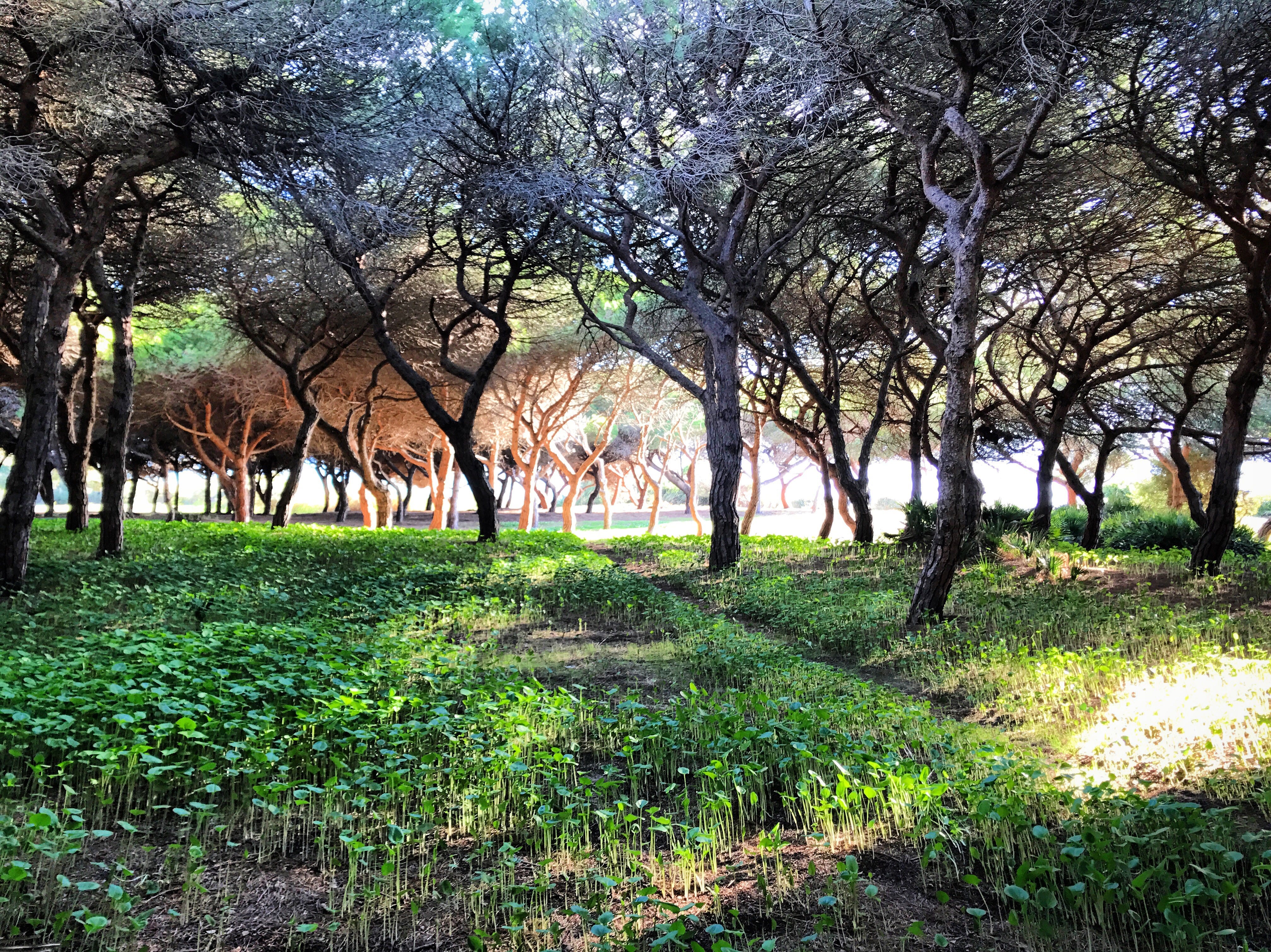
My mother is a bad ass. She’s 71, lives alone in the middle of the Spanish countryside, raises chickens, goats and sheep, smokes Marlboro lights and likes her G&Ts with Bombay and lime. She recently dead up red eyed it over from seeing an old friend in Canada to make my Significant Birthday in the UK, then proceeded on no sleep to stay up until 4am to watch England beat Mexico in the World Cup.
Like any parent, she has her foibles. And so, while I will state unequivocally that I love my mother and am a loyal and attentive son, she has on occasion been known to exaggerate.
This is why, one April afternoon last year, when she came into the abandoned pig shed my father converted into a home office, I didn’t immediately believe what she said.
“The power’s out across all of Spain and Portugal.”
I’ll admit I was sceptical. It sounded rather far fetched, not least because the home office’s lights were still on. Then I remembered the solar panels. It was true, too, that the Wifi had cut, but this far into the wilderness of southern Andalucia, that isn’t at all uncommon. I checked my phone: no signal.
Around half an hour earlier, my mother’s friend had been on the phone to her daughter in northern Spain, when the power suddenly cut. There had been enough residual network for her daughter to scan her news feeds and within a few minutes reports started dripping through of a widespread power outage.
I went to the house and tried the landline, it being the one thing in the home connected to some mains supply - no ring tone. It certainly looked like the power was out in our little corner of Spain, at least.
With work no longer a possibility, I decided to do some journalism; I took mum’s car and drove the mile or so to town to see what was happening. Sure enough, the whole place was without electricity. Petrol stations and supermarkets were already shuttered, most bars and cafes had closed for the day, although some landlords were doing their best to empty their fridges of cold beer for the office workers who had been sent home for the afternoon. Outside one bar on the main street, a group of men sat in plastic chairs arranged around a table laid with a bottle of rum, a bowl of ice, and a wind-up radio. I sidled up to them and listened to the Spanish government’s back up communication system, a relic from the days of Franco.
It was true, then. Virtually the whole of Spain and Portugal had lost power, authorities were trying to ascertain the issue, and they were refusing to rule out sabotage. The word that I would go on to hear hundreds of times over the next year was on the lips of presenter and listeners alike: Apagón.
The word derives from apagar, meaning to turn off. In Spanish the suffix -ón is reserved for expressing largeness, sort of like the opposite of -ito. Perhaps the most common of these is botellon, meaning literally “big bottle” but understood by all as a large social gathering. Although even small, localised power cuts are also called apagónes, in this case the sound fitted the scale. The power cut of April 28, 2025, the biggest in Spain’s modern history, will forever be known as El Apagón.
I walked around the corner and went into a mini-market. The owner had dragged her two teenage sons out laden with meat from their home freezer and was instructing them to sequester it at the depths of the shop deep freeze. I asked them what they reckoned was happening and they responded, in unison: “Putin!”
I then proceded to perform a relative of panic-buying, perhaps “unplanned buying” would fit. I hadn’t brought any bags with me although I did have some cash, and so I flitted around the shop picking up whatever I could carry back and which I dimly discerned might be useful in the event of a prolonged power outage: two boxes of passata, a bag of lentils, three cartons of UHT milk, and as many thawing frozen bread rolls as the owner had fished out to make way for the meat. Seven, it turned out.
It wasn’t until I was back at the house when I remembered everyone else.
Two nights earlier, mum had celebrated her 70th birthday, and many of the guests had booked a few extra nights’ stay in town. This included a few quite senior family members. So I drove around town, checked up on them, and invited them to dinner at the house that evening (at least there we would have light, cold drinks, and a place to charge phones).
With my sister and nephew also around, and with no work for any of us to do even if we wanted to, we made an impromtu call on something we’d been meaning to sort for a while now: scattering dad’s ashes.
My father had sat in a cuckoo egg blue urn on the kitchen windowsill for the past two winters after dying and being cremated following a brutal but mercifully short battle with a brain tumour. When I think back on the day of the funeral, I recall only lead-lined visions of pallid faces, of mask-marred mouths and bad coffee and the sting of the fundador I took in stealthy swigs from a hip flask I borrowed from his best friend.
Spanish funerals are rather different from Anglo-Saxon ones - they are typically just a day or so after death and are reserved for unexpurgated grief. They are not occasions to “celebrate the life” of a person, they are for mourning alone. The on-the-bright-side part comes several weeks later, when the physical pain of the loss has numbed slightly.
We, or at least I, tried to do a bit of both that day, but it wasn’t until well into the wake that the Spanish contingent thawed enough to catch up with the British, who, in time-honoured style, were putting away bacchinalian amounts of red wine and laughing with love at my father’s many inadvertantly hilarious and unedifying moments.
(One story that went down well with Spanish- and English-speakers alike: Dad was deeply respected in town, the way the Spanish like and adopt an Englishman who speaks their language but who also gets them, on something close to a spiritual level. I remember the day me and mum went to the printers to get some orders of service ready for the funeral. The guy at the computer who I’d never seen before pulled up the picture we’d chosen of dad and he shook his head hard. I asked if there was a problem with the lighting or the resolution. He said, no, it wasn’t that. He just knew my dad as a good man and was moved at his dying. Anyway, my dad would always give lifts to anyone who asked, both into and out of town. One day, the mayor’s brother-in-law, himself a minor local dignitary, asked for a lift from the campo back into the centre. The area is renowned for its wind - it is the wind and kite surfing capital of the world [we will get to this presently]. It was a typically blowy day. I happened to be visiting my parents and I was fond of this chap - he seemed kind and sensitive in the macho world of squalid backstabbing that is local politics - so I tagged along for the ride. As the brother-in-law was getting out of the car, a sudden gust of wind blew his cap off his head. My dad, in his idiosyncratic Spanish, forever peppered with Malopropisms, meant to shout: “Cuidado, tu gorra!”, which might not be grammatically perfect, but which conveys the message: Watch out, your cap! Only what he actually said was: “Cuidado, guarro!”. Guarro is a synonym for pig, but more colloquially means something closer to dirty fucker. After a moment of shocked silence, we all laughed in relief about the loss in translation.)
We had always intended to scatter his ashes on the beach, the part away from town when the sprawl of apartment blocks gives way to brush, farmland, and the fincas that rear the fighting bulls. Beyond all that to the clotted light of the pine forest, its ground a bed of needles and sand, which should be terrible for dogs’ paws but which is made soft and spongy from the sea mists. Here, specifically, for two reasons: it was my father’s favourite place on Earth, and it was far enough away from civilisation to avoid attention (scattering ashes in public places is not only seen as deeply sacreligious in Spain; it is also illegal).
We picked up my sister and her little family and drove out to the pines, keeping an eye on the guardia civil who were positioned sparsely across the coast; it’s only 12 kilometres or so from Morocco at this point, so they were presumably keeping any eye on any would-be smugglers trying to take advantage of the loss of power and comms.
There had been no shortage of advice as to how we were to scatter dad. He had, after all, sat there right next to where we ate dinner each night; I would always say hi to him when I got back after any extended absence. His natty, rather cheap looking urn the result of several too many decisions made in the throes of crisis, one more pointless detail to determine that really didn’t seem to matter in the moment. One friend suggested decanting him into a plastic bag, then snipping a small hole in one corner. Handled properly, the idea went, we would be able to secrete him slowly like an hour glass, imperceptibly scattered on the breeze as we walked across the sand. Another said they would do it in stages: take a small tupperware of him in a pocket, and deposit a little each time we walked the dogs, Shawshank Redemption style.
Given our resolve to do this today was entirely spontaneous, we didn’t really have a plan as such. That I was the one to physically do the thing was a given - I was the doer now, it was me (and my mum and my uncle, who was wonderful but unable to be around constantly) who had taken on the task of administering the horror of dad’s dying - the wheelchaired trips across flooded parking lots, the conversations with tired and distracted medical staff, lifting him into bed that day the radio waves from that loathsome machine finally fried what was left of his brain and rendered him weaker than a baby. Mine was the job of keeping the fire going over that lost winter, of buying a hospital bed for him so he could lie facing the ceiling in the house that he built in one final staring contest with the ever after. Change the drip bags. Buy more adult nappies. Make sure the lorazepam (anxiety), the midazolam (breathlessness), morphine (pain) and cyclizine (nausea) are topped up on the regular. It was me who watched over his body as dawn crept up on that day - the first day of Spring, World Poetry Day, all the beautiful and promising things - after an exhausted and frankly relieved mum had had one final G&T toast with the nurse before bed (told you she was a bad ass). I called the ambulance, and waited as they came and dispatched my father’s corpse to the morgue. It was on me to dismantle and re-sell the hospital bed, a 1000-euro purchase that we ended up needing for a grand total of 9 nights.
Do not get me wrong, I wasn’t alone. I had help from overwhelmed and terrified loved ones. Times like that you manage the best you can. The days of losing dad were, in some way, almost magical in their surreal half light. But I felt immense loneliness then and I carry that with me still.
We start our pilgrimage over the pine needle bed, the sun shooting like shrapnel through the writhing branches, the dogs bounding ahead and my little nephew tottering after them like some drunk miniature shepherd.
We take the stone steps down to the beach and the tide is quite close, leaving only a slither of the beach running like a vein between sea and scrub. The wind has picked up. Locals have a colour coding system for wind strength, and I’d say we were now a solid orange, the Levante wind, the same that trembled Homer’s wine dark sea, now pulling through the reedbed in strong, insistent gulps.
We wander for a few minutes, not resisting the wind, leaning into it and letting it buffet us down the headland. We get to where we get and decide that here is about as good a place as any. I take dad out of the urn, and there is a little plastic wire tab to negotiate that no one ever shows you in the films. I hold the bottom of the bag and turn it upside down. The gale whips dad at wharp speed across the sand and sea, taking away forever and finally our world on the wind. There is the faintest smudge of him left on the beach, like the dust left behind when you touch a butterfly’s wings.
That night we all gather at mum’s, and I cook the lentils and tomatoes I bought a few hours earlier (when we still possessed dad). It is one of those unruly nights, where everyone feels tacit permission to cut a little loose, extentuating circumstances etc. I feel lightheaded and, to my surprise, lighthearted. There is nothing left to be done: dad’s ashes have been taken care of, we have food (and power points to charge the phones), we have wine, and we have each other. There is something, for the first time in a while, approaching contentment. People like the lentils.
There are seven of us, and I got seven bread rolls.
The days after the Apagón are rather more profane, and I spend them trying to counter a baffling narrative that the power cut was due to Spain’s large use of renewable energy.
It is quite remarkable: the lights had barely gone back on before people who have frankly zero knowledge about energy systems are going on record and claiming that the Spanish grid is uniquely vulnerable to this type of cascading outage. This is not true in point of fact, and I spend a few hours one day trying to gather some data to use as a corrective whenever the point is put to me in interviews (a regular occurrence over the coming weeks).
The short version is that there is simply no correlation between the amount of renewables in a country’s energy mix and power cuts. The Spanish government itself commissioned a review into the events of April 28, which identified a variety of contributing factors included a sudden voltage surge due to grid instability and a failure by utility operators to predict the correct energy mix. You can read more about that here.
Perhaps the least impressive part of the fossil fuel lobby is that they feel no need to adapt their narrative even when it’s been baroquely debunked. We live in the age of Brandolini’s Law - also known as the Bullshit Asymmetry Principle - where a lie gets around the world before the truth has its pants on (this to me explains why newsrooms’ collective response to the Fake News high watermark failed to stauch the drift from fact-based empiricism that has infected even well-meaning media discourse. We have a suggested remedy to this, and you can check that out here.)
And so we fast forward to the summer of 2026, The Great Burning, and That Front Page, a juxtaposition so grotesque that one struggles to find the words. It’s the This is Fine meme made broadsheet.
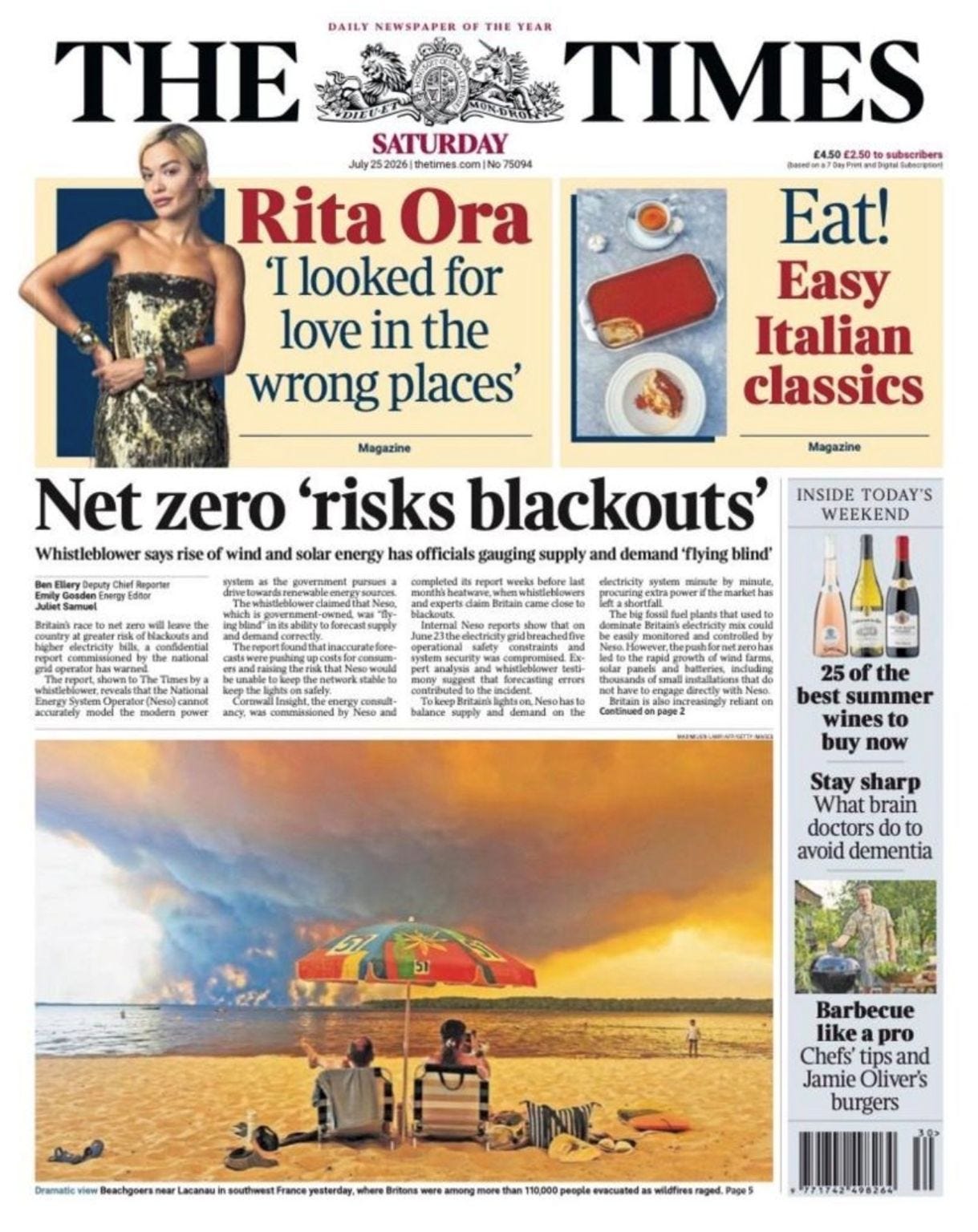
Clearly, it matters not in the minds of some decisionmakers and “thought leaders” whether or not a narrative happens to be true. It only needs to be sticky.
I’ve written a fair bit over the years about how people’s inability or unwillingness to Say The Thing fans the flames of misinformation, constrains society’s capacity to adapt, and retains what are now largely imaginery barriers to the kind of system change that all the science is screaming we need in order to secure a liveable future on this dying planet of ours.
As it’s summer, it’s also profits season, and my team has been tracking the money that the people most responsible for driving climate breakdown continue to rake in, a wealth transfer out of all proportion to the governing logic of capitalist progress, an extinction windfall that, as millions of people face starvation due to climate linked crop failures and societies across Europe pick through the smouldering rubble of what used to be their lives, is a civilisational shame that history will not forgive.
Just eight companies, according to a recent Guardian analysis, made $90 billion in profit in Q2 of 2026, not only during a climate collapse that has seen Europe burn, but also during a Bible promise war where the mechanised slaughter of Iranians and Lebanese is being abetted by everyone’s favourite cuddly generative AI provider.
I can lay no claim to credit for that work, nor can I fail to highlight a wonderful piece of fleet-footed leadership and initative by my colleague, but basically I ended up quoted in the Guardian’s splash. This led to some follow up interview requests, including one from CNN.
I did the interview early and on little sleep, but I’ve gotten a bit less anxious over live hits this year, and I felt it went OK. Watch it here if you like.
It unleashed a flood of comments, as all content these days apparently and regrettably must, and it got me thinking about all sorts of things, including my journalistic background, my pedigree as a communicator, my life without my father, and of apeirgons.
An apeirogon, a portmanteau of two Greek words - apeiros, meaning infinite or boundless, and gonia, meaning angle - is a geometric shape with an limitless number of sides. It is a name for the infinity sign, you know the one: ∞.
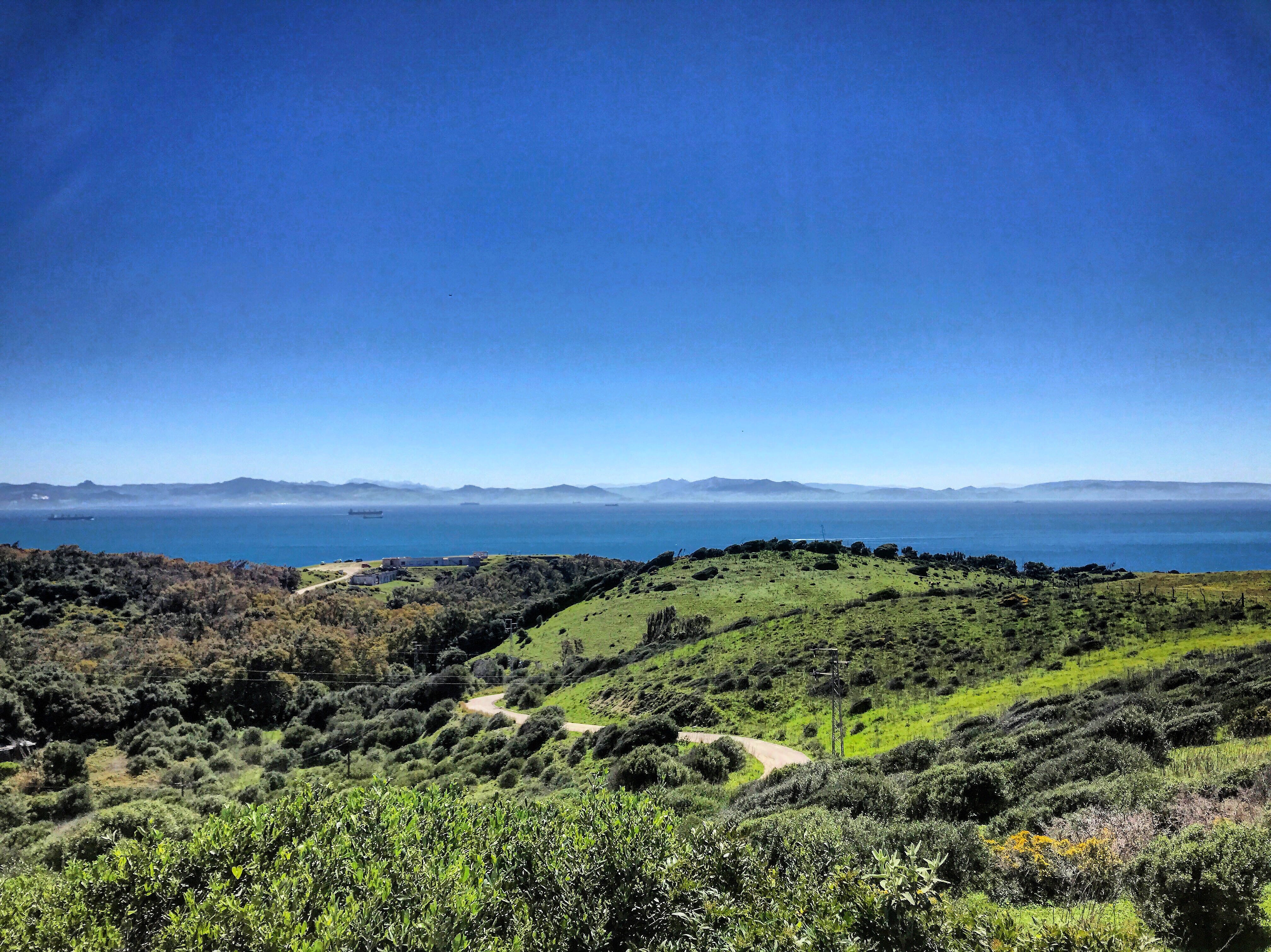
I think of these a lot when I am in Spain, whenever I walk over the hill from mum’s house and behold the Strait. It’s about how the Sun hits the sea (the part of the coast is known as the Costa de la Luz and is famed among film producers for the quality of its light). The rays bounce off the waves in a breathtaking variegation, flashing white and bright like magnesium skating over the water.
In reaction to the CNN interview, I was both praised for the clarity of my message and criticised for my vagueness - a classic case of beauty (and, in 2026 it seems, truth) residing in the eye of the beholder. I was fed really interesting (and potentially valid!) critiques of overly negative communication over the climate breakdown, much of which find a sympathetic reader in me, even if I won’t go so far as full agreement. We know that despair only benefits the bad guys. We know that we have to bring people along with us, meet them where they are, and hold people’s hands as you look them in the eye and explain slowly in what precise flavour we are all fucked.
Maybe I am over the hill and over the top with my pessimism, but it has been five full years since you were all warned really specifically what lies ahead and I need more of you to actually look at the thing and engage with it. I need you to take it to your bosses, to your union reps, to your pension fund and local politicians. Shake it in their faces the way you shake your fist when you protest any other social crime. Then again, I know how scary and painful it is to stare directly at the future, and I won’t blame you if you can’t hold its gaze.
The philosopher Timothy Morton calls climate change a “hyperobject”, something that is too out of scale to the human condition for mere mortals to usefully contemplate. To me, it is an apeirogon: something that impacts us all, in varying ways, and which excites an infinite number of perspectives even as it is - perhaps because it is - too huge and unweildy to behold in full.
For the vast majority of people (80 percent of so) navigating the daily toil of living in a city, climate change will mainly be experienced as excess heat (in Europe we are now girding for the sixth heatwave of this infernal summer). That is the most obvious effect of our warming climate - longer, more intense and deadlier heat. For those lucky enough to have access to artificial cooling, these are periods that must be navigated judiciously; for those without, it will be as much as they can manage to simply survive. In either case, they will need to be negotiated without predictable access to electricity, as a combination of excess heat and drought has left our power grids at the very edge of breakdown. The city people will see the end of the story: empty supermarket shelves, law and order collapse, overwhelmed hospitals and fear stalking the streets.
For those, like my mum, living in rural areas, they are going to experience the climate collapse at a different point in its narrative arc. Theirs will be the fields plucked bare by plague or dessicated in the withering heat. The threat of wildfire will lay crouching just beyond the horizon, and your life, home and everything you’ve spent your days working to build up will always be hostage to wind and flame, nature’s cruel caprice.
There’s a small constituency who see an opportunity in the crisis, who will use the intervening years between now and whenever our global food and water systems collapse to grow even fatter from an inhuman hunger, from a greed that may never be sated. You are free to listen to these people or ignore them, just know that they will not be spared. They may admit the boat is sinking when the water reaches their necks, they may not. There are infinite perspectives on climate collapse, but the climate doesn’t care for any of them.
Perhaps that is what is so disappointing: we have for too long treated the natural world, our only home, with the same contempt it now glowers back at us. That more and more people are suddenly starting to notice, to fear and to rebel, matters nothing for the atmosphere we have so ruinously soiled. The climate crisis is uncaring. It is a daily memento mori: none of us are special, it will get us all in the end no matter how we feel about it. It will not respond to reason, to bribery, pleading or threat. How are we supposed to deal with that?
These days I feel a fatigue I’ve never known before, like I’ve been holding back the tide and my arms and shoulders are beginning to fail under the strain. They were not meant for such an effort. I am trying to protect people and things I cannot keep safe, and it might be that there are men equal to the task but I’m coming to accept I’m not one of them.
I have been to the hospital. Tests have been performed. I have low haemoglobin, apparently. This tracks. I lack the very stuff of red-bloodedness.
The weather, surely, cannot help. I can’t remember the last night I slept well, it is the unnatural heat, the open windows, the fretful breeze. The fucking seagulls. Let’s say if you’re exceptionally lucky (luckier, indeed, than my dad, who considered himself to be the luckiest guy ever), if you’re lucky you get 80 summers. I’m at half that and I cannot remember one of genuine consequence. I know that others will come but I find them hard to picture. The future eludes my vision. The whole earth is bleached, and I can’t imagine what could bring the colour back. The very concept of rain now seems absurd, belonging to another geological time.
I met up recently with one of my oldest friends. He’s a teacher, and that is good, because there is wisdom in what he has to say. He introduced me to the concept of The Status Game, how we view ourselves in comparison to others, and how it is a lifetime fool’s errand to chase that which will not satisfy even once attained. We talked about efficiency in art, about the pleasure to be derived in the destruction of the creative process, whittling down our work until it is lean and tight and bears its weight with economy and purpose. I suppose we were also talking about how we ensure our messages are received, how we as humans engage with other humans.
My friend is a settled person - he finds the outlook that suits him best and he sticks with it until events or invidividuals disabuse him of it. He is effortless in the liminal bits of life, comfortable in the not knowing, suited to the uncertainty that shadows being human.
We talked about the failure of philosophy, how so much is given over to contemplating experience and perspective (even, with regret, Morton) and how truly unequipped it has left us to deal with the important, inevitable tasks of life. How am I supposed to act when my dad dies? What should I do with the anger I feel when my friend is killed and the driver evades punishment? When I’m running on empty and feel really dangerously close to life spinning apart in total? Tell me what to do. Please, I am asking for help.
We are told nothing, or, rather, I have retained nothing from philosophy on what we are meant to do when faced with moments of unreconstructed being. It seems it is on us to learn, the hard way, through viseral, painful lived experienced as we are emotionally overwhelmed and spiritually malnourished. Maybe that’s the point: if you can keep your head while all around you are losing theirs etc. Maybe it’s the trial of it all that’s the thing. There are simply some situations that cannot be war-gamed. Not every play has a dress rehearsal. If you can withstand the enormity of force that loss burdens you with, try to make do as best you can and if you’re lucky and up for it apply a little grace and even humour to the moment while you’re in it, and make it out the other side knowing that that more darkness awaits to be encountered and overcome. That might be all we can hope for.
All this is to say that nothing exists to prepare us to respond to climate change. As a concept, as a phenomenon, to its physical and immediate impacts and threats. There are practical guides to meaningful personal action, which a lot of study suggests people are most hungry for - how can we do our own little bit, share the burden a little more collectively, sacrifice the disposable parts of the needs of the individual for the good of the general.
There are things we can do to better prepare, phyiscally. Those fortunate enough to own their own homes (something that still eludes me) can future proof them, making your entire family more resilient to the next big weather shock, and all those that will follow. While you have less room for manoeuvre as a renter, you are still not powerless.
At my mum’s, she now has a grab bag to take with her should she ever again need to flee fire or navigate the world without power (the bag contains among other things a Moroccan SIM card so she can still communicate even if, as last April, the Spanish networks all go down together). Local authorities across the UK are rolling out wildfire evacuation plans. If you see one near you, sign up.
Take names. I am doing so. And there’s more and more of us holding historic polluters to account.
Remember what is probably the coolest thing about being you: you can change at any point. If you’re someone who is constantly late, you can choose to end that habit of a lifetime right now. Within a few weeks no one will even remember you were ever late in the first place. The same is true for your climate work. You may not have spent two minutes over the last year thinking about how you can help, it may be way down your list of priorities, but you can change that. Right now. It is a superpower.
Recognise your power as a person with the agency to influence others. People tend to listen to people they know and respect, and you can change them. My dad, for example, went from being a life-long meat-eating small business owner and motorbike racer to a self-sufficient eco-warrior and a card-carrying member of the Green Party. (One of the proudest moments of my life was at the funeral, where my aunt took me by the shoulder and said: “You changed him, you know.”)
In particular these days acquaintances tend to be less enthusiastic about their sustained use of Generative AI tools when I point out the environmental and social damage of their supply chains.
Talking to friends and families about what is to come helps them see how it applies to them specifically. Most people aren’t ignorant of the scale of the problem, they are intimidated by the size of the barriers to solutions. Help lower them.
This can be done in a manner that is non-preachy, and judgement free. This is your opportunity to bring your people along with you. The difficulty isn’t in not knowing what needs to be done, it resides instead in convincing enough people that the system we currently have needs to undergo unrecognisable change.
If you’re anything like me and consider yourself to be relatively well up on the science and economics of climate change, you will likely be surprised by other people’s unawareness of truths you hold to be self evident.
They probably aren’t aware, for example, that fossil fuel organisations are money-takers not money-makers (especially unaware during bumper profits reporting seasons such as currently). Oil and gas firms receive $7 trillion in taxpayer handouts each year; this is the only way they can remain going concerns, because the system is rigged in their favour. They do not provide us with energy security. They are little more than social and economic parasites. They need to be treated as such.
Your friends may have heard and may even repeat the tired untruths of the industry, especially in the UK around the North Sea. Equip them with the corrective. (North Sea oil and gas won’t lower bills, won’t create more jobs, and isn’t any greener than imported fossil fuels).
I bet your friends don’t know that as much as two-thirds of the energy generated when burning fossil fuels is simply lost as heat and doesn’t contribute to energy systems. This means that we don’t need to replace the equivalent energy from oil and gas with renewables - we need less than half. This massively lowers the barriers to change. Enlighten them.
Did you know that the food we feed to animals could feed a billion people every year, without any additional production? Or that more land is used to grow food for animals than it is to grow food for humans?
Ignorance - its usage may be a little strong here as it is rarely willful or cynical on these things - is as much a fuel to forest fires as is parched woodland; misinformation can run wild only in a vaccuum free from trenchant truth.
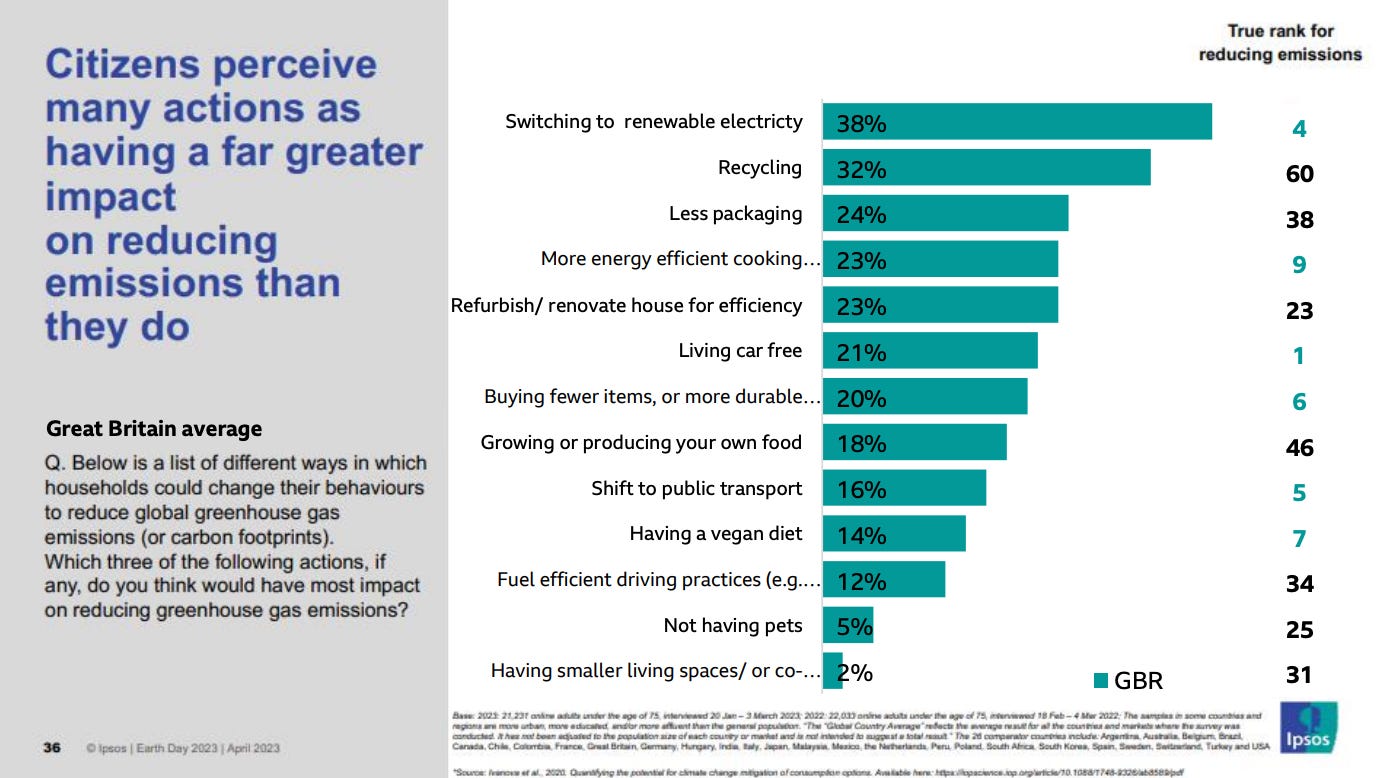
As a society we are generally well meaning but often poorly directed (see chart). I don’t think it’s incumbent on us as individuals to make small sacrifices as the rich industrially gorge off our finite resources. But we can make personal changes, and enough of those, we know, can build up to something significant pretty quick.
And don’t forget the social movements that have materially changed the world. I was in Brighton for Pride weekend this year and it was a joyous celebration of love and belonging. I was speaking to a friend of mine who is a bit older (though they don’t look it). He said he could remember a time when he would be shouted at in the streets and worse for being who he is. The progress, although there’s always work to be done, had been headspinning for him.
I don’t need to list all mass participation efforts that have achieved an extent of their aims throughout the 20th and 21st centuries, but (given I am writing a book on the topic) I offer an excerpt as an example, in the form of two cities. It is a tale of citizen-led enduring social and civic change via inclusive design. There’s civil disobedience in there, road rage, horses, and “bicycle rabies”. It is long, I’ll admit. So feel free to skip to the end of the highlighted section. But I hope some of you find it enlightening:
Anyone who has ever visited Amsterdam, the Netherlands’ canal-crossed jewel, will attest that it is a city owned by bicycles. Cyclists swarm along a network of 515 kilometres of dedicated bike lanes, powering themselves to work or towing improbably heavy loads on cargo bikes, carrying multiple children on their way to nursery. It is consistently voted in the top two most cycling friendly cities in the world (the other being Copenhagen, which we will come to). In all, around 63 percent of Amsterdam residents cycle on a daily basis - around 650,000 people - compared with around 12 percent of people in the US who cycle each day. A commonly held view, that Dutch people are somehow more culturally keen on cycling, is a classic case of confusing cause and effect: people in Amsterdam don’t cycle lots because they are genetically or socially predisposed to cycling. They do so because their city is a safe, clean and welcoming place to cycle in. Because bicycles are prioritised over motor vehicles in infrastructure, from roads to parking to maintenance access. And because bicycles have been integrated into people’s daily lives, improving their physical and mental health while cleaning the air they breathe. None of this was inevitable. It all came about due to popular movements that influenced policy.
It might be hard to imagine today, with everyone from school children to pensioners getting around by bike, but cyclists were once virtually wiped out from the streets of Amsterdam by the apex post-war transport form: the motorcar.
As far back as the 1920s and 30s, the bicycle was king on Dutch roads, with 3.5 million bicycles registered in the Netherlands by 1937, compared with just 91,000 cars. Increased average wages and the economies of scale augured in by the establishment of several national factories meant that most households could afford at least one bike, and motor vehicles were very much still the exception on the road.
“Cyclists dominated, as did pedestrians, with a few passenger cars or trucks interspersed here and there,” writes Ton Welleman in the Dutch transport ministry’s 1999 paper, The Dutch Cycling Master Plan, which tracks the progress of cycling in the world’s most bike-mad nation.
The outbreak of World War II and Nazi Germany’s occupation of the Netherlands brought a shuddering end to cycling’s heyday, as bicycle tires were seized in an attempt to make up for a shortfall of rubber across the Axis powers’ European territory. In addition, German troops requisitioned up to 50,000 bicycles within the space of a few weeks in July 1942 in an attempt to alleviate pressure on their supply chains and get soldiers travelling more freely. One German serviceman reported how this did nothing to ingratiate them to the locals:
“The Dutchman, who is practically born on a bicycle, views the seizing of his bicycle to be nearly the worst thing that could ever happen to him.”
Consequently, by 1943 there were 55 percent fewer bicycles in use than just three years previously. The Nazis also instigated something of a psychological shift in attitudes towards cycling. Welleman describes their view that the large number of cyclists in the Netherlands were “bothersome”, leading to the introduction of “fast” and “slow” traffic rules which gave motorised vehicles the right of way across the country. This system was only overturned in legislation at the turn of the millennium, with cyclists having their right of way restored after some 60 years ceding priority to vehicle traffic.
After the war, demographic shifts, including soaring “baby boomer” populations and universally rising incomes meant that vehicle use exploded in the Netherlands; the total number of kilometres travelled by car went from 4.5 billion in 1950 to 89 billion in 1975, with the average number of car users undergoing a similar transformation, from 139,000 in 1950 to 3.4 million nationally in 1975. Welleman offers a number of explanations as to why the increase in total distance travelled in the Netherlands in the second half of the 20th Century was made by car. The number of households in the country roughly doubled between 1950-1975 to 4.4 million while the percentage of professional workers rose 44 percent. Cities began to sprawl outwards, decreasing urban density, meaning more commuting and visiting was done by people able to afford motor vehicles and who were more likely to need to travel further to their workplaces.
At the same time, the extensive damage inflicted on major national infrastructure such as roads during the German occupation meant successive governments fixated on short-term regeneration, prioritising big, US-style transport routes that encouraged car use over more local solutions that would reward cycle-first behaviours. Budgets for road construction flourished meanwhile, increasing nearly three-fold between 1965 and 1971, which incentivised ever greater car usage.
From 1950 to 1975, Welleman writes, “the bicycle was almost entirely excluded from the government’s vision”.
(It’s perhaps important here to state that while there was very little by way of pro-cycling policy in Dutch local or national planning in the third quarter of the 20th Century, there was at least no obvious, concerted anti-cycling policy drives either. This was not the case in many other European nations; Germany, with its powerful auto-lobby, has seen sustained smear campaigns against the bicycle).
Inevitably, increased vehicle traffic led to an ever higher accident rate among cyclists, offering a further disincentive against undertaking a journey on two wheels. Within just 20 years, the rate of road fatalities increased by 200 percent to stand at 3,300 deaths a year. Tragically yet crucially, more than 400 of those deaths were children. Such unconscionable waste of life prompted mass outrage, and it wasn’t long before anti-vehicle protest movements got underway. One of the children killed on the road in 1971 was Simone Langenhoff, a six-year-old who was hit by a car on her way to school. Her father, Vic, was a journalist for the De Tijd newspaper. He penned a front-page article headlined Stop de Kindermoord, or: “Stop the Child Murder”.
The article tapped into an underlying feeling that the country was being developed without the consent of its population, turning spaces that were once safe for children to move around into potential death traps. A pressure group inspired by the headline started to hold a number of ride-by demonstrations (a tactic still in use today in many major cities). They also occupied accident blackspots and arranged special days on which streets would be closed to vehicles to allow children to safely play on them.
Stop de Kindermoord’s founder, Maartje van Putten, who went on to be a Dutch MEP, was a young mother at the time who had personally witnessed several traffic accidents in the city in which children got hurt.
“I saw how parts of the city were torn down to make way for roads,” she said in 2015. “I was very worried by the changes that took place in society – it affected our lives. The streets no longer belonged to the people who lived there, but to huge traffic flows. That made me very angry.”
Others followed suit. Two years after Stop de Kindermoord appeared, another group of activists founded the First Only Real Dutch Cycling Union to press for greater space for bicycles in both cities and the public’s consciousness. They organised bike rides along dangerous stretches of roads, compiling lists of problematic encounters with motorists, and also painted guerilla bike lane signs along some of Amsterdam’s main thoroughfares.
All of this may have amounted to little more than a passing protest movement, similar to the once-weekly Gilets Jaunes demonstrations that gripped France in 2018 before slowly petering out. But the year after the foundation of Stop de Kindermoord was founded, another factor, governed by geopolitics and macro-economic bottom lines, was added to the pro-cycling policy mix. In October 1973, an Egyptian-Syrian coalition of forces invaded the Sinai Peninsula, which had been occupied by Israel since the 1967 Arab-Israeli war. The move sent fears of a nuclear conflict soaring as both the US and the USSR sought to bolster their respective sides. It also had a profound effect on oil prices. Censuring them for their pro-Israeli stance, Saudi Arabia and other major producers slapped the Netherlands with an oil embargo that sent the price of petrol soaring. Internationally, the shock was so profound that Western oil majors began investing in research on alternative power sources, including on the prototype lithium ion batteries for which its scientists would go on to win the Nobel Prize in Chemistry several decades later. Domestically, it all but crippled the Netherlands’ ability to import oil and led the then Prime Minister Den Uryl to deliver a televised address imploring citizens to adopt lifestyle changes and to start thinking about ways of saving energy.
One measure to reduce reliance on oil was the establishment of the same “car free Sundays” in Amsterdam which we see today in many cities around the world. Add to this a 1972 report from the Dutch Economics Institute - which Welleman labels as “pretentious and shocking” - which calculated the cost of updating the country’s travel infrastructure by building new and broadening existing roads at an eye-watering 22 billion guilders (around $7 billion today), and all of a sudden the policy environment was right for cycling to be prioritised once more.
The 1976 Passenger Transport Plan formalised a focus on empowering “slow” journeys - i.e. undertaken by foot or bike - through a four-point programme that included limiting the growth in car use and building better and safer bicycle routes. In the same year, the national Ministry of Transport introduced two financial incentives for regions and cities to opt for more cycle-friendly infrastructure. The first entitled local authorities to receive payment from national coffers for any new bicycle facilities, while the second subsidised 50 percent of the cost of tacking on cycle paths to existing road networks. Both were spectacularly successful: between 1978 and 1988, the length of bicycle paths in the Netherlands increased from 9,300 kilometres to 16,100 kilometres, an increase of 73 percent within a decade.
But something strange was happening. In 1975 two cities, The Hague and Tilburg, constructed two high quality, dedicated cycling routes, painted bright red to differentiate them from vehicle traffic lanes. An assessment a few years later found that the new routes had done virtually nothing to increase the cycling rate in the two cities. Although the lanes themselves were popular and well-used, just one or two dedicated cycle routes appears to be insufficient to encourage more people to cycle. What people needed, planners concluded, was an entire network of cycling infrastructure - a small-width grid integrated into cities with a maximum distance between dedicated cycle lanes (one 1981 study suggested no more than 500 metres between cycle paths).
The poster child for this new, holistic approach to cycle promotion wasn’t Amsterdam, but rather Delft, a city of some 90,000 people situated between The Hague and Rotterdam. Twenty-nine million guilders was allocated to construct a three-tier cycle network of bike paths on a city, district and neighbourhood level in what Welleman describes as a “nearly complete network of bicycle routes”. The results were modest. While bicycle uptake and cyclist safety both rose slightly during the pilot period, the initial bump in the number of cyclists (up some 6 percent) wasn’t sustained beyond the first few years. Nationally, while the government added more than 7,000 kilometres bike lanes, Dutch people simply weren’t cycling all that much more (12.8 billion kilometres were cycled in total in the Netherlands in 1990; in 1994 that had increased to only 12.9 billion kilometres).
Eventually, it dawned on policymakers that it wasn’t just a case of encouraging people to use their bikes more. As Welleman wrote in his now-famous evaluation of the Netherlands’ Bicycle Master Plan: “The simultaneous execution of a policy discouraging car use is (also) deemed necessary.” That is to say, the carrot of cycling more would only move the needle when combined with the stick of driving less.
In November 1989 the transport ministry invited activists, industry groups, politicians and external consultants to participate in a brainstorming session, the results of which were integrated into the Second National Transport Plan of 1990. The two-pronged approach evidently needed since the Delft pilot included measures such as restricting car use in various areas, raising the costs of car use compared to that of other modes of transport and “significantly improving” alternatives to car use, such as public transport and the bicycle. Major cities such as Amsterdam started charging more and more for vehicle parking, and road and fuel tax increases added to the pressure on motorists. Traffic calming measures in major cities have proved successful in not only slowing down vehicles (making each journey take longer and therefore less enticing), but also in improving pedestrian and cyclist safety, which again builds up the number of people practising “slow” transport over “fast”.
In tandem, the plan also focused on ways of reducing bicycle theft, developing better infrastructure such as bicycle routes and parking facilities, and allowing bikes to be carried on public transport such as trains and trams. In something of a first, the legislation also set concrete targets on air pollution reduction, including lowering nitrogen dioxide and carbon emissions from car traffic by 75 percent by 2010, lowering CO2 emissions at least 10 percent - as well as reducing the number of traffic fatalities by 50 percent and injuries by 40 percent. A win-win-win.
Welleman’s assessment of the numerous laws, pilots and local initiatives to get more people on their bikes and less in their cars - to make, in his words “the bicycle the obvious choice of transport” for as many journeys as possible - shows two things. Firstly, it illustrates the huge potential of mass cycling movements. He writes how “practically everyone cycles; young and old; men and women, rich and poor,” meaning there is a sound policy basis for expanding cycling. Secondly, it shows how governments need to start thinking about new and publicly palatable ways to generate the same “push and pull” dynamic practised in the Netherlands. It is not enough to make cycling a pleasure for people - you also have to make other, polluting forms of transport more painful. Balance is key. One only need look at the Gilet Jaunes in France, or the outbreaks of public rage in Chile and Sri Lanka in recent years when governments have tried to remove subsidies on cheap public transport and vehicle fuel without providing cost-equal alternatives.
In a major 2022 survey across 28 countries, the polling firm Ipsos asked more than 20,000 people to give their opinion on cycling, its role in helping the environment, and the major impediments that still exist barring mass uptake. While twice as many people polled (64 percent over 36 percent) agreed that new infrastructure should prioritise bicycles over automobiles, 52 percent said they believed the roads were still too dangerous for them to cycle more regularly.
The Netherlands, by the way, has continued to reap enormous benefits from its cycle-first approach. Since bicycle use was prioritised in national planning in the mid-1970s, the number of children killed in road traffic accidents has fallen an astonishing 97 percent. The average resident’s annual CO2 emissions have gone down more than a third since the mid 1970s. Deaths from air pollution have nearly halved since 1990, the first year for which such data is available. The monitor Environmental Justice Atlas evaluates that the Stop de Kindermoord movement had lasting and visible environmental, health, justice and socio-economic impact including improved air quality meaning fewer days lost to associated illnesses and a better and healthier environment for children.
If there is one city that consistently challenges Amsterdam’s claim to be the most bike-friendly place on the planet, it is Copenhagen. Everyday, residents of the Danish capital travel some 1.2 million kilometres on two wheels, which, up until as recently as 2012, was almost as much as all Americans combined cycled on a daily basis. Copenhagen easily leads the league table in terms of percentage of journeys undertaken by bike, with some 62 percent of people cycling to get around. In terms of commuting, Copenhagen is just 1 percentage point behind its stated goal to have half of all journeys to work undertaken by bicycle by 2025. There are admittedly a number of things in Copenhagen’s favour, here. For one, it is exceptionally flat (during the first three stages of the 2022 Tour de France, held in Denmark, the longest climb on the route was the Great Belt suspension bridge that links eastern and western parts of the country). It is also relatively compact, meaning that most journeys are short distance and therefore easily - in theory - undertaken by bike. As with Amsterdam, the history of cycling in Copenhagen might have turned out very differently indeed without sustained bike use advocacy. The human ecologist Stefan Gossling has argued that Copenhagen’s modern infrastructure has “roots in an existing bicycling culture” that stretches back more than 100 years, which made it easier for cycling campaigners to push against an open policy door and ensure that development plans kept their needs in mind. But as Martin Emanuel, a researcher at Sweden’s KTH Royal Institute of Technology argued in his 2019 paper in the journal Urban History, the relationship between cycling and Copenhagen city planners is more complicated than it appears at first glance.
The story begins at the turn of the 20th Century, a few decades after Copenhagen embarked on an unprecedented expansion of a capital that was until the 1870s contained within fortified walls. The rapid development of working class neighbourhoods - known collectively as brokvarterene, or “bridge quarters” due to the nature of their transport links to the old centre - coincided with the release of “the safety”, a bicycle with two equally sized wheels that was much easier and safer to ride than previous models. As early as 1887 there were 35,000 bicycles in Copenhagen, one for every 10 inhabitants. Once the preserve of the rich and eccentric, mass production meant a far greater proportion of people could cycle. At this time most streets were made up of a cobble-stone roadway for horse-drawn carriages, with pavements for pedestrians and a horse track running in between, often made up of soft soil. When local police rules were up for review in the early 1880s, the city council granted cyclists access to use both sidewalks and the horse tracks, a move that enraged horse riders and which led to increasing tension between cyclists and horsemen.
“Horsemen, many of the military officers, considered cyclists as intruders, and complained about cyclists scaring the horses and their failure to pay respect to the rule of conducts,” writes Emanuel, in what might be the earliest written account of road rage involving a cyclist. Knowing they had numbers - and the inalienable feeling of progress - on their side, Copenhagen’s cyclists took matters into their own hands. By riding repeatedly on the edges of the horse paths, riders compacted the soft soil suitable for horses’ hooves into a smooth, firm service perfect for bikes. In doing so, they had created Copenhagen’s first cycling lanes. City authorities, wishing to signal their view that the tracks were intended for horses, would occasionally plough the soil and cut up the packed edge, making it harder to ride on. But in 1891, either through neglect or nuisance, authorities left one of the narrow hardened sections on a major horse track untouched, ushering in a tacit municipal acceptance of cycling’s physical space in the traffic hierarchy. Several other tracks were soon left intact, and the most popular of these self-made tracks would go on to be Copenhagen’s first official cycle lanes.
The pushback from horsemen was almost immediate and, in a sign that some things truly never change, cycling became embroiled in what can only be described as a late 19th Century culture war. Under pressure from horse enthusiasts, who as Emanuel alluded to were more likely to come from higher and therefore more influential sections of society, the police proposed banning cycling from horse tracks as well as from a number of main streets. In addition, bicycles would be subject to registration and have to carry mandatory licence plates such as those instituted a few months earlier in Stockholm. The debate was front-page fodder for two weeks ahead of a decision in mid-1895, with most speakers including union leaders and council members expressing their support of cycling. One leading anti-cycling voice was the conservative lord mayor, Ludwig Christian Borup, who lamented that it was “somewhat dangerous to quarrel with the bicyclists”, complaining that Copenhagen was suffering from a form of “bicycle rabies”.
Although the precise place of cycling was not fully settled then, city planners did informally proceed with allowing, if not encouraging, bicycles, adding specialised lanes along many large roads under construction. In 1905 the Danish Cyclists’ Federation was founded as a formal front for the lobbying of various pro-bike groups. They decided to take an empirical approach to show to city planners the folly of continuing to insist that horse tracks were primarily meant for - and, therefore, used by - horses. Traffic counts in 1906 showed the ratio of horsemen to cyclists on the tracks to be somewhere in the order of 1:200. On one weekday in June a studied horse track was found to be used by 9,378 cyclists and only 18 horses. It was not just the amount of bicycle riders that interested the DCF, however. They also observed certain trends, such as peak cycling use in rush hours and a strong increase in bicycle use on weekdays, which proved to them that cycling was “not just leisure riding, but emanates from thousands of inhabitants making use of the bicycle as a means of transport to and from their work.” This was obviously in contrast to the recreational riding of horses among the upper classes.
Guided by this data, municipal engineers were tasked with establishing a network of dedicated, smooth bicycle lanes that unleashed the first true cycling revolution along the streets of Copenhagen. By 1913, in a city of half a million inhabitants, Copenhagen was home to 80,000 bicycles. Such a grass-roots development of cycling infrastructure, driven by values rooted in the utilitarian use of bicycles, is an early example of people-powered policy we would do well to emulate today: as the number of cyclists in the city became too great to ignore, bicycles ended up being folded into planning, regulated as traffic and accommodated in infrastructure development.
The interwar years for cycling in Copenhagen suggested that two-wheel transport was there to stay. As the city sprawled outwards, many new radial roads connected suburban communities with central areas, and most were equipped with bike lanes. Not even the Great Depression could stem cycling’s rising popularity - while total traffic on Copenhagen’s streets increased by a quarter over all in the 1920s, cycling was by far the fastest growing transport mode. By 1935 44 percent of all residents used a bicycle as their main means of getting around. The extent of cyclable roads more than doubled between 1912 and 1927 from 35 to 74 kilometres, and by 1935 was almost 100 kilometres. Although German occupation during World War II led to similar dips in both cycling rate and the number of available bicycles similar to the Netherlands’ experience, by 1950 cycling in Denmark had recovered to pre-war levels. Emanuel puts this partly down to agreement among all parties on the bicycle’s pre-eminence in Copenhagen, not just the vehicle itself or the thousands who used one each day, but the city’s planning had been so influenced by bikes that “the urban transport system would be dysfunctional without them”. It also didn’t hurt that the government suppressed car ownership after the war through a limit on imports and subsequent high taxes.
The real make or break moment for Danish cycling came, as in the Netherlands, when shifting demographic pressures from growing and increasingly decentralised populations appeared to play into automobile producers’ hands. Beginning in the mid-1950s, bicycle use began to decline in Copenhagen, particularly along main thoroughfares where new tram and bus lines were cropping up. For example, cyclists’ share of traffic along the bridges between the main island of Sjaelland and the smaller Amager to the southeast, where the city’s main airport is located, dropped from 70 percent to just 20 percent between 1955 and 1970. Policymakers’ attention on cars and public transport had sapped attention to such a degree that, Emanuel writes, by the 1960s “hardly anyone mentioned the bicycle anymore”. Cycle lanes, the presence of which became harder to justify outside of peak hours, began to be removed, with the capital region’s cycling network some 25 kilometres shorter in 1974 than it was in 1970. Yet despite this regression in bicycle infrastructure, Copenhagen residents remained doggedly attached to their bicycles: a 1967 survey found that 21.5 percent of commuters and 32.7 percent of school children still rode on a daily basis.
The economic crisis of the mid-1970s hit Denmark just as it did most of the developed world. Its recovery was markedly slower than similar-sized economies and so, pressed by the cost of living and especially high fuel prices, Danes flocked back to the bicycle. The 1973 oil crisis galvanised Copenhagen’s grassroots environmental movements as authorities abandoned several major road projects - partly due to their cost, partly due to their growing unpopularity. At the same time, a variety of measures proved a lasting disincentive against cars entering central areas, including pedestrianised streets, harsher speed limits and prioritised zones for public transport. Sensing its moment, the Cycling Federation lobbied authorities to develop their own cycling master plan, then pressed ahead with its own that constituted plans for nothing short of cycling utopia: 92 kilometres of new cycle lanes within 10 years. While the plan was never officially adopted, it served as a guide for planners to develop what today is a world famous bicycle network. The period from 1975 to 1985 was the watershed moment for Danish cycling, seeing the fastest growth of bicycle infrastructure in Copenhagen’s history. The city’s rebirth from the 1970s economic mire took longer than most, but when it came the bicycle was its beating heart. With its population and GDP booming, the city embraced cycling as a key tenet of remaking itself as a liveable, modern city. Such was cycling’s importance to how Copenhageners saw themselves, that the issue has decided local elections over recent decades, with the most pro-cycling candidates more likely than not to reach and stay in office. And while young professionals in and around Copenhagen own ever more cars, they still prefer the bicycle for their daily commute (car use in Denmark actually declined in the decade to 2013 despite higher ownership).
In Emanuel’s telling, the story of cycling in Copenhagen is one of precisely the kind of collective action, data-led policy asks and community-led development that many of today’s cities would benefit from. In its starring role isn’t some visionary leader of a cast of innovative, future-facing civil servants. The hero in this story is the cyclist themself. Through collectivisation, they ensured their priorities were represented when it came to urban planning, meaning that new systems would be suited to their needs, engendering the long-lasting and frequent usage against which successful infrastructure projects are measured.
“Cyclists pushed things forward,” says Emanuel. “The slow acceptance within the municipal administration in the 1970s of infrastructure provision for cycling in other than ‘easy’ locations suggests that little would have happened without pressure from cyclists and their representatives, and thus highlights the importance of rebels and resistance in the co-production of infrastructure systems.”
A group of informed individuals, armed with good data and a shared vision, can change the world. The point I want to make here, is that the climate crisis is now inevitable, but how we react to it is anything but. There is nothing immutable about how our future looks, about what we choose to prioritise as the measure of what constitutes a good life. How happiness happens. One friend recently told me it could be something as simple as how many books they got to read in the sun each year, and I found great beauty in that.
Finally, I suppose most elementally, I want to ask you to keep doing and making things. I don’t mean that as a kind of irreverent “Eat, pray, love” carpe diem maxim. I mean it because ultimately, in this dizzyingly short life of ours, what we do is the thing that matters.
My dad constantly told me a man (he meant person, but he was, forgive him, a boomer) is what he does, not what he says. He meant this quite literally: he built houses for a living, he was a maker of family universes. The output of your physical and spiritual tasks are all that we will leave behind when it’s over.
So, please. Do the things. Make the things. Write that poem. Pick the blackberries. See your friends. Protest. Organise. Walk on the beach. Swim in a pond in the rain. Get your toes in the grass. Feel the sun on your face and bathe in the quiet of the moment. Resist the urge to look too far beyond. All the self-help people and the therapists out there all agree so there must be truth in it: anxiety means you’re living too much in the future. Remember to enjoy the present. Even in 2026, it’s still good, there’s still value in it, despite all we have already lost and all that is to come. There is beauty in loss; in possession, also.
This may sound like a trite end to a long ramble about power cuts and polemic. But I truly mean this: inaction has gotten us in this mess. It is only through action that we will survive it. History has shown us what works, what doesn’t, and what it takes to head off the pushback so we safeguard the win for the most people possible. It takes stamina. It takes focus. Send some energy ahead for yourself. You’ll need it.
Not to speak on your behalf, but I’m ring rusty. I’ve felt, particularly recently, paralysed practically by the heaviness of the whole thing. I hope to be in a position where I can do more, to be more, to be a better person to the people who value and rely on me. The power will go out again. Next time, I’ll be more ready.
Deeds not words
Patrick, wow. Have been struggling with eco-grief and this was exactly what I needed to read. Eager for your book!