

Omar Mukhtar was born in 1858 into a poverty that would have looked little different back at the dawn of the Ottoman Empire to which his hometown still belonged.
Cyrenaica, as old as ancient Rome, was a neglected outpost of Constantinople’s rusting dominion, a Libyan province dominated by the forested foothills of Jabal Akhtar, a mass of sun-bleached limestone pocked with snatches of woodland, maquis and garrique.
Mukhtar’s family, like most families, was dirt poor. His father died when Mukhtar was still a child, whereupon he was taken in and raised by the local Mashayakh, a small collective of religious scholars. They had adopted a student of remarkable powers.
Mukhtar took to learning the Quran with the zeal of a young man given a second chance in life. As a teenager, he never slept more than half the night, spending the sibilant hours until dawn prayer whispering the Holy Book back to itself.
The first half of Mukhtar’s life is recorded only in moments and virtues. Once a week, regardless of his situation, health, or safety, Mukhtar would recite the Quran in its entirety. At one point, he pops up in Sudan, appearing like a djinn on horseback, to face down a lion and shoot it in the head.
In 1911, when Mukhtar was 53, Cyrenaica was invaded by the Italian army, in an occupation that would become the clarion call of 20th Century Europe’s prototype fascist dictator, Benito Mussolini.
Mukhtar led a clutch of rebels in a decade-long onslaught against the colonial forces, rising quickly to prominence as a brave and canny guerrilla commander. Dodging the shells of Italian tanks and strafing fighter planes, Mukhtar’s band of 3,000 men on horses launched wildcat skirmishes against occupying troops.
The resistance was so effective that, by the time Mussolini had risen to power as Il Duce, Mukhtar’s muhajideen were clashing with Italian troops hundreds of times a year. In an unhinged and inhuman attempt to staunch the damage, the fascists set up concentration camps throughout the region, at one point holding 100,000 Bedouin men, women and children — around half of Cyrenaica’s total population at the time — in open air prisons.
Whenever one of Mukhtar’s band was captured alive, the Italian soldiers would subject them to gratuitous torture before death, displaying the ballooning corpse in the street for days as a warning.
Mukhtar would eventually be captured by the fascists and, after refusing their entreaties to stand his militia down, was publicly hanged in 1931.
But it is one scene from a year earlier that I want to tell you about today.
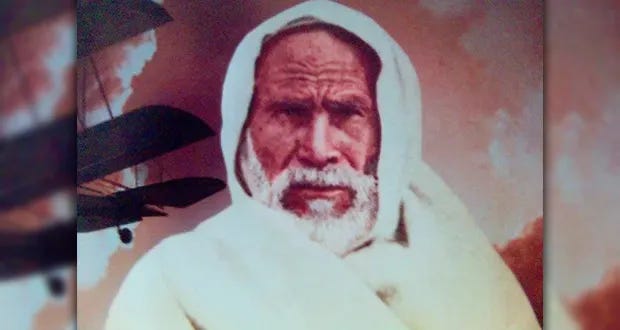
After another successful raid against Italian positions near Tobruk, Mukhtar’s men captured two fascist soldiers alive. One of his closest aides, a general, made a suggestion:
“Why don’t we make an example of them like they do to us?”
Mukhtar refused.
“But they do it to us,” the general pressed.
Mukhtar placed his hands on the general’s shoulders, looked him in the eye, and said:
“These people are not our teachers.”
Some mornings I wake up exhausted, drenched in grief, crushed by the formless and empty day that stretches out ahead of me with no prospect of joy or surprise. All that awaits is the news, the images of fire and drowning.
I gather the sadness around me and wear it like a coat. It weighs down on me like a field of dew, slumping my shoulders and bowing my head in one, day-long cower.
Recently several friends with young children have reached out to me nursing the pain of climate grief, jolted into fear by the terrifying heat of a future arrived too soon.
It is a grief we share.
The record-breaking heatwaves across Europe last month that shattered glass and salted the earth. Terrifying heat. Murderous heat. Heat that killed thousands of people, that led to more than 130 drownings across France and Germany as panicked humans, their reptilian brain trip wired by the unnatural and unbearable heat, fled like early man into the sea. Heat that boiled children alive in their cars.
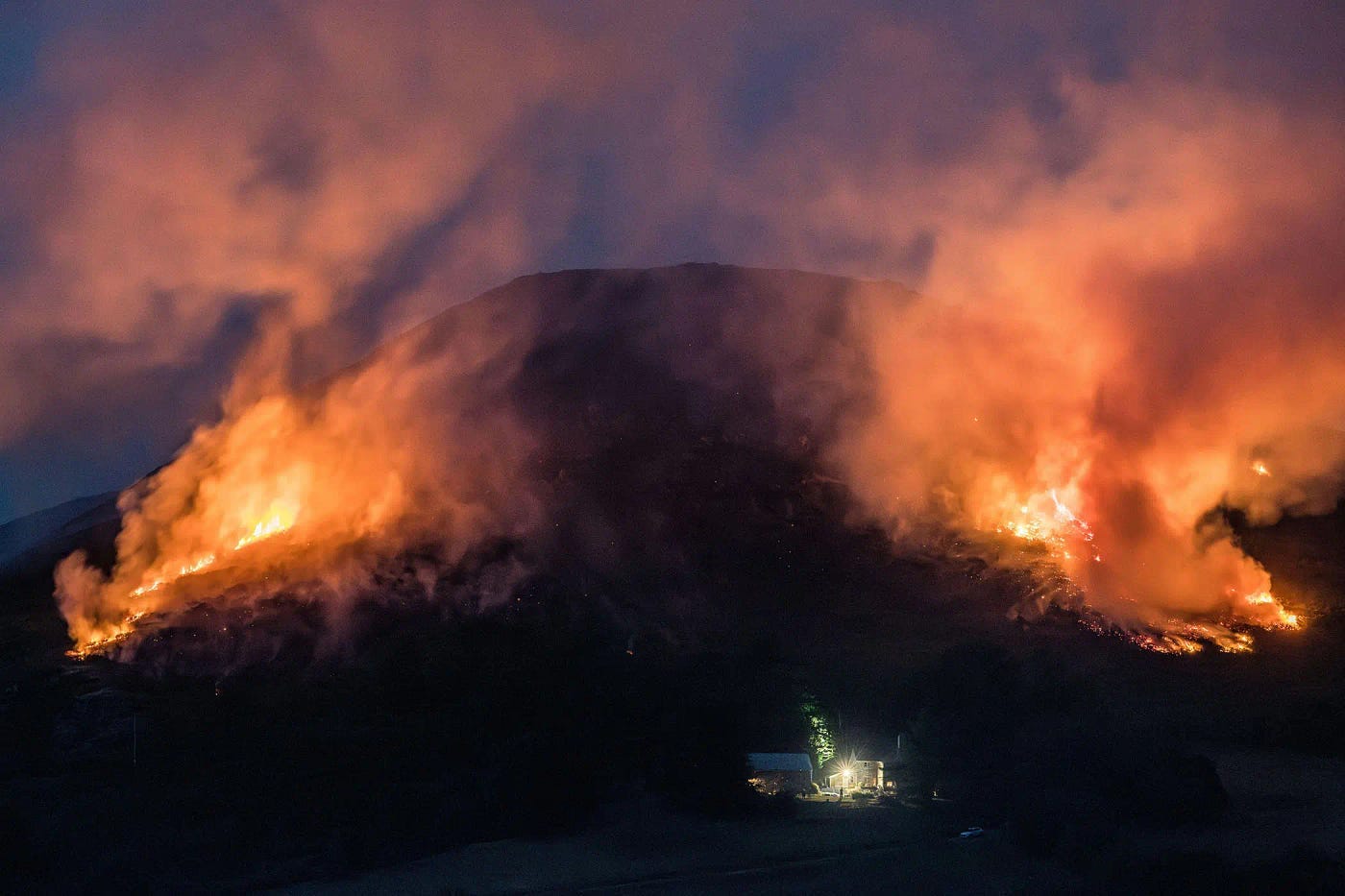
Heat that torched fields and forests. That warped and buckled train tracks. Heat that returned tarmac to bitumen. Heat that in Spain, where I recently spent a week’s torpid leave battling food poisoning, literally vaporised tourists who failed to heed evacuation orders.
A summer of smoke and ash. A summer of violence.
During the record-breaking 10-day peak in the UK last month, we sent thermometers to primary school teachers and asked them to record classroom temperatures. They came back with readings as high as 38C.
They told us of children complaining of headaches and nausea, of crying out for their mothers as they were subjected to temperatures up to 12C hotter than the recommended safe maximum.
What scares me most is not how head-spinningly unprepared we are for the type of heat that our burning of fossil fuels has made inevitable. It is not even the fact that we are — in 2026, a decade on from the Paris Agreement and at a time when solar and wind power is cheaper nearly everywhere on the planet than new oil and gas projects — actively accelerating climate breakdown through our ever increasing greenhouse gas emissions. Each year new record pollution. Each year new record profits.
No, what scares me the most when faced with the death and disease and exhaustion and pain that comes with future heat, is that, unless we stop the fossil fuel industry from profitably poisoning us to death: this will be the coolest summer for the rest of our lives.
Now that the heat has subsided here (although the drought looks set to persist, and more heatwaves are in the gun’s chamber), now we have some distance between us and the animal fear of those firebombed days, I’ve been speaking with some of my friends with young children.
Mostly they are after some context. A few are exceptionally up on the science of climate change, others know intuitively that Things Aren’t Alright.
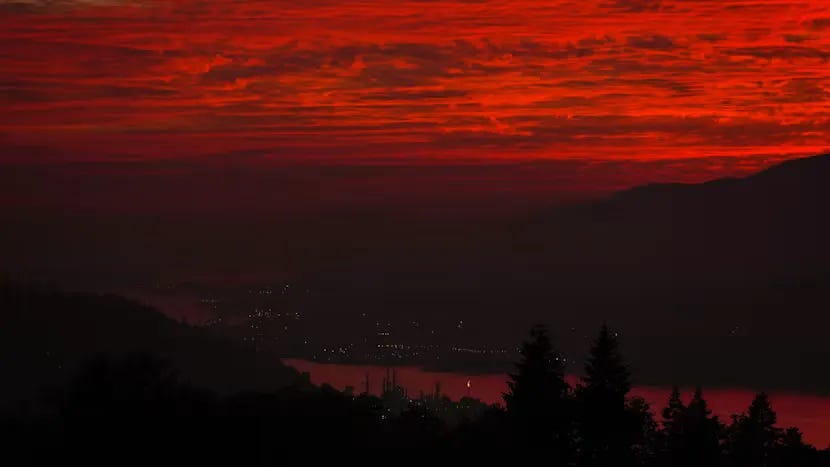
One old friend messaged me — I was walking down the hill towards the sea and I could see the sky was diluted, milky like watered ouzo. Turns out the smoke from the wildfires raging in Canada has spread across the ocean and is now smearing our horizon, supercharging our sunsets and sunrises.
These days disasters don’t stay put for long.
She asked me about RCP8.5, which is a now-largely-disregarded Business As Usual scenario for global heating. She had been speaking with another friend, also a mother, and had come away from the conversation with the impression that climate change might not be as bad as predicted.
I have my own views about the de-facto retirement of RCP8.5 (Briefly: It’s true that on a pure emissions basis we are not on course to burn the fossil fuels that would make RCP8.5 a reality from a straightforward radiative forcing perspective. However, I am constantly dismayed at scientists’ inability or unwillingness to factor in Black Swan phenomena, such as any of the numerous planetary tipping points — from albedo decline, ice sheet decay, boreal forest loss etc. etc. — that could lock us into a feedback loop of warming.)
So we talked that through a bit, and then she said to me:
“It’s really getting to me. I worry so much about the world I’m leaving for my little one. How do you stay hopeful at the state of the world?”
And I thought of Omar Mukhtar.
I have a nephew with golden locks. They coil in ringlets and shine peach in the sun. He has the mischief of his father, his mother’s gift of the gab, and he is happy and healthy and sassy. He is nearly three. He is the apple of my eye.
By the time he is my age his world will look rather changed. I cannot tell for certain which load bearing function will fail first in the climate breakdown, but my best guess is that it will be our food system. I have written for years on the structural vulnerabilities imperilling humankind’s ability to move calories around the world so that everyone gets enough.
All the risks that the food system has faced in the last 60 years — crop failures, supply chain bottlenecks, food loss and waste, geopolitics — these are all compounded by a heating climate. Climate change is a threat multiplier.
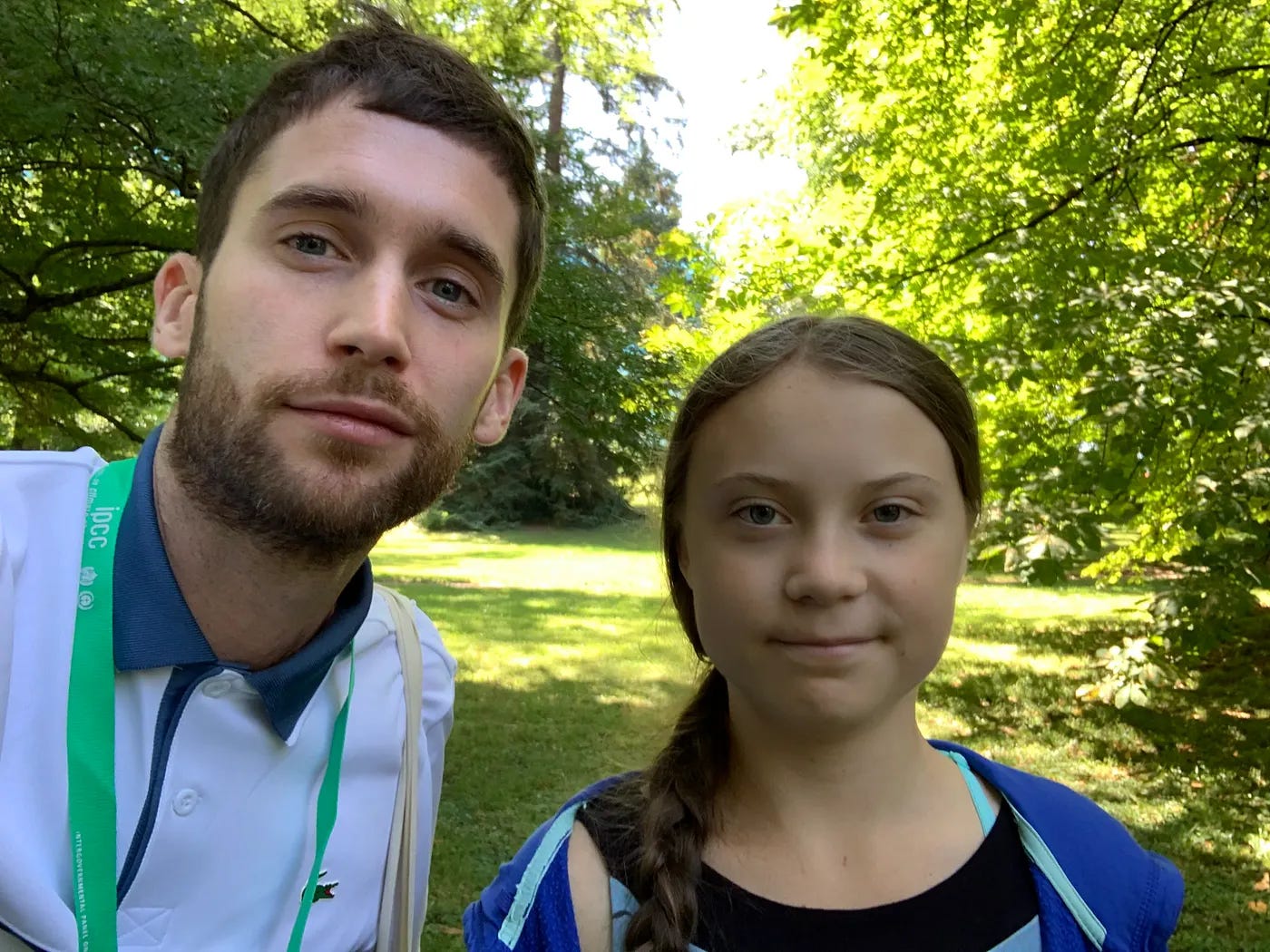
In 2019 I was in Geneva for the launch of a special UN report on land use. It was a warm and rainy week spent along the banks of the lake, meeting with experts from the Intergovernmental Panel on Climate Change to go through the dizzying findings of their 1,300-page assessment (I also got to hang out with Greta again, which is always a pleasure!)
I was trying to get to the bottom of what the scientists were, in their diplomatically redacted way, warning the world about.
I had the embargoed Summary for Policymakers — essentially a political synopsis of the findings — but I couldn’t make it out: what was the take home here? There were so many competing dynamics, entirely divergent possible pathways based on policy choice, a sort of superposition of scenarios, all of which could be true but only one of which that would be.
I had coffee with one of the most experienced scientists to work on the panel, a senior North American woman who I had known for years and whose work I had always followed closely. In a world of hypotheticals and certainty tolerances, she always had the most plastic of takes. She told me:
“It means a reckoning. We cannot continue to treat this planet as if its resources are infinite. Hard choices, trade offs. There is no business as usual anymore.”
As I listened, and she explained what some of the report’s modelled pathways meant to the lay person, I gathered that humanity was at a crossroads in how it tackled its two most pressing sustainability challenges: not just how it physically sustains itself (food systems), but also how it sustains the circumstances that allow it to sustain itself (Earth systems and climate). We could either feed 10 billion people by 2050 or use land to limit global heating. Food or forests, you can’t have both.
The warning went ignored. After several years of political and popular momentum behind climate action, with the largest companies and countries in the world issuing pledge after pledge to reduce their emissions, we reached a collective high watermark of action. Then the pandemic hit. Governments, desperate for a return to normal, doubled down on our fossil fuel powered economy, providing unprecedented amounts of taxpayers’ money to oil- and gas-based regrowth.
People who had dabbled in staycationing or vegetarianism were sick of months of privation and forced compliance and cut loose. The climate suddenly became less of an item of emergency intervention than a distant curiousity. An abstract, something too large and too out of scale to the human condition for people to engage with meaningfully. Humanity’s greatest ever challenge became a “not now” problem, buried beneath the mundane toil and routine drudgery of living (and making a living) in the 2020s.
Aside from the corporations driving our oblivion and the politicians they pay to look the other way, I apportion no blame. Life for so many people around the world is still nasty, brutish and short. Even those of us (such as myself) who live a life, relatively and historically speaking, of unimaginable privilege still struggle with the day to day white noise of modern life, the drain of the capitalist experiment, and the toll it takes on you physically, emotionally and psychologically.
During periods of extremity, where we hide the shadow as fear lays panting in the white hot street, the feeling of things rapidly unravelling can hit you like vertigo: the realisation that the emergency is happening, that the time to panic is now, save yourselves and your loved ones because this disaster isn’t a movie. It has come.
I remember sitting in the waiting room outside the ICU at the hospital in Marbella. My mum and my sister were back at the house, an hour’s drive away, using the period where the anaesthetic wears off to nip home and get a change of clothes. Mum had slept 5 nights straight on the lino sofa next to my dad’s hopsital bed. I felt flighty, like I might drift away on the slightest breath of breeze.
Me and my sister coined a term for it, a shorthand to use in the coming weeks to express the mixture of anxiety and hysteria we were all feeling, knowing that something dreadful lay in wait: I felt fizzy.
The surgeon came out, and shook my hand. She could see I was alone and frightened, and I will forever thank her for taking the time to speak slowly and clearly through the surgical mask (this was at the tail end of Covid). She put her arms on my shoulders, looked me in the eye, and delivered my father’s prognosis: grade 4 glioblastoma.
I knew immediately that he would die. I had passed through a threshold between life and certain death, and I’d passed instantaneously, before my dad even knew he was a dead man.
It took another 86 days for death to come. He fought it. At first, he fought with bravery and purpose, the same grit and stubbornness that had served him so well in life, allowed him to bend reality to the force of his will and build a universe that he viewed as worthy of my mum and us. Then, as the treatment stopped, and the pain increased, he began to fight pointlessly, in all directions at once, even with the people looking after him in his final hours.
I am told we are lucky: we “got to be with him” at the end, in the home that he built, not in some medicalised ward surrounded by masked strangers and the cold, unfeeling beep of monitors. I’m not sure. He still died about as hard as a man can die. It was squalid and awful and undignified.
But knowing he was going to die, the annihilation of hope for anything better, was — for me at least — oddly liberating. It did bring with it a type of mindfulness, a determination to live more in the present, enjoy the small irrelevances of each day, to make the most of the now extremely finite time I had left with my dad, one of only two people in the history of the universe who will ever love me unconditionally.
Knowing the worst was now inevitable removed much of its jeopardy. I didn’t have to catastrophise anything: for once, there was no scenario planning or war gaming to be done. I just had to adapt to events.
This summer reminds me too of the night Notre Dame caught fire. It was a Monday, I was just finishing up my shift after filing my last story of the day — probably around 1830 or so. I worked in a big newsroom in the 2nd arrondissement, a huge spaceship of an office block landed right opposite the Palais Brongniart, Paris’ former stock exchange.
The newsroom of course had many TVs, and as I was leaving my desk I looked up and saw some breaking news: Fire reported at Notre Dame. There was some live ground shots from the Ile Saint Louis of the back of the cathedral with what looked like a worrying amount of smoke coming from its roof.
I ran from work a mile or so south to the Ile de la Cite, across the Seine by the Pont au Change, which the police hadn’t had chance yet to close. I was stopped in my tracks by what I saw: the whole of the roof was ablaze, flames licking the famous fleche, and thick smoke was pilloring into the spring sky.
Security soon arrived and kicked us away to the other side of the river, right outside the Hotel de Ville, where I stood with thousands of other Parisians watching with mounting horror as the flames crept ever higher. I took a video of the moment the fleche collapsed; as I watch it back now the crowd noise is one of prehistoric pain and fear.
I, like half of Paris it seemed at the time, spent most of the night on the north bank of the river, the fire raging on as the sky darkened. Being a wire journalist, I had a direct feed on the latest developments.
It was shortly after 9pm that President Macron announced that the towers of Notre Dame, the twin turrets that had stood watch over Paris for 800 years, which had survived plague, revolution, famine and war, which held firm even as the sans culottes stacked dynamite and firewood at their base, which didn’t succumb even during Bismarck’s fire bombing or Nazi occuptation — those towers were now at risk of collapsing.
And I kept thinking the same thought: this is happening on our watch.
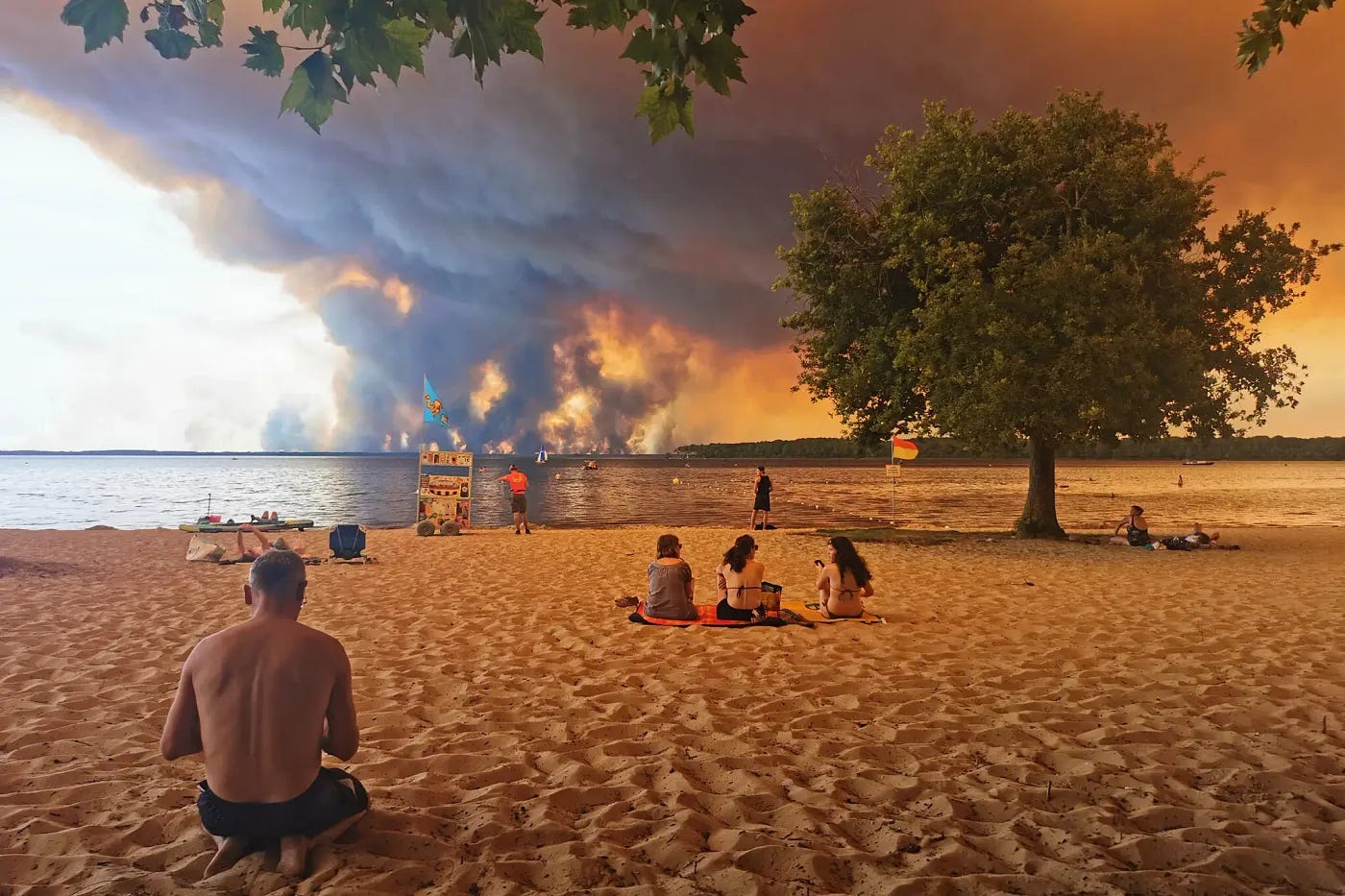
Now they are evacuating Bordeaux. The fires that have burned for three days around the Bay of Arcachon are increasingly ungovernable. 250,000 people have been told to leave with just the clothes on their backs. They are even shortening the last stage of the Tour de France so security personnel can tackle the inferno.
Several towns west of Madrid have also been evacuated, and the prime minister is warning that the wildfires are now entirely out of anyone’s control. We are in god’s hands, it seems.
This is happening on our watch: the great burning. These fires are the inevitable, immutable result of the last 150 years of fossil-fuelled growth.
We have spent the last several generations incurring a debt to nature, spewing out ever greater clouds of pollution and calling it progress. That debt has largely, so far, been paid by the global majority, with uncalcuable loss and damage wrought for years already on the societies least responsible for the problem.
The debt is now here for us all. We knew it would come. Most of us (myself included) assumed we would have a little more time, that we would at least make it to 2030 or 2040 before the worst excesses and privations of climate breakdown would make themselves unignorable.
Sometimes you come across a piece of writing at exactly the time you need to. Last week, I was doomscrolling as usual, looking at the monstrous El Nino that’s coming down the line this year, when The Milder Sun by Gregory Normington popped up on my feed.
It is a story of filtered hope, one set 200 years in the future, after humankind has undergone the maelstrom of collapse, the collapse of society and systems that our fossil fuel addiction has made inevitable, before emerging, burned and blinking, possessed by a gossamer purpose to rebuild the world for people and nature.
I like it because it doesn’t shy away from the loss and pain that is waiting for all of us. It’s just that the loss and pain, in Gregory’s telling, isn’t the end of the story. He outlines how it is going to be: the institutions governing our world will disintegrate as the social fabric spools apart, cascading collapse across our food and health, energy and housing systems, then a period of post-impact desolation, followed by slow, thoughtful, determined rebuilding.
I ask his permission, and quote from the key narrative crux of the piece:
Two centuries ago our planet was locked, seemingly inexorably, in what we call the Locust Years. The intentions that had led to the great devouring were not all ignoble. Billions had been lifted out of absolute poverty by fossil fuels and everything they enabled. But it was ancient power, stolen from the bosom of Earth where she had sequestered it for millions of years, and loosening it broke the balance of the world. A terrible and — at first — entirely accidental experiment in atmospheric chemistry was conducted on all living beings.
The biosphere is ruthlessly coherent. It rations life for the individual to maximise it for the totality of living things. Humanity’s foundational and entirely natural sin was our compulsion to reverse that formula. And so the carrying capacity of our planet — the only known refuge for life in the Universe — was stretched to breaking point. Weather systems warped and buckled; soils, overworked, began to fail; the oceans acidified; a great silence spread across what had been the wild places of the world. Most governments and corporations, and the media empires that existed to further their interests, tried at first to ignore what was happening, to deny it, to spread confusion, and thus to delay a transition that threatened what they perceived to be their wealth. These efforts met in many quarters with willing collaborators, for a civilisation with a pathological inability to contemplate its mortality will spawn morbid symptoms. People so feared positive change, clinging to what hurt them, that negative change — Gaia turning on those that abused Her — accelerated at harrowing speed. Still the plutocrats, soaring in their private jets above the burning, fought attempts at evasive action, or indulged in fantasies of technological supremacy, imagining that they could shield themselves behind their quarterly finance reports.
The Locusts seemed unshiftable. Yet as things worsened, those we call Earth Tongues began to cry out in alarm. They were few at first, then a growing chorus. Children refused to attend school, meaning to shame their adults who refused to learn what they had a duty to know. The Locusts, of course — in whose image the world seemed to be made — would not listen, for hunger drove them on. It was not biological hunger, for which no being need feel shame. It was the diseased hunger of people driven by a lack of love and connection. No amount of eating can fill those voids: they seek in taking what can only be found in giving. In the Locust Years, it seemed society lacked the vocabulary even to speak of these things. Cynicism and mockery were the norm; illusion and neurotic distraction were easier than facing reality, and much violence was done to the very notion of truth. The Earth Tongues had to shriek and holler, increasing in volume even as what they feared roared in the ears of all living peoples. How easy it was, as cities choked on wildfire smoke, to despair. Many did. But while we have always been our greatest foe, we are also our only hope.
The struggle was titanic, first to slow the speed of destruction, then to stop and reverse it. For many years it seemed impossible. The graph lines soared towards calamity; forests burned, crops failed, people perished. There were vested interests hindering action. Yet slowly, then less slowly, finally at dizzying speed, these obstacles — technological at first, at last cultural and political — were swept away. Raw economics worked, for once, in Life’s favour. Solar became the fastest growing source of energy in history. Together with wind and geothermal, and batteries to store what they generated, it put out the fossil flames. Transportation, heating, and industry were electrified. Electrons replaced molecules and brutal cartels lost their power — though not without a fight. Within three decades humanity said goodbye to the heat engine that had powered and poisoned it for three centuries.
Technological change was essential to our survival. Some of the Earth Tongues were uncomfortable with this, and the trade-offs it required. They were right that technology alone was not enough. Rather, it bought us time to transform ourselves. Cities became places for people rather than the machines that had seemed to serve us. Most of us became city-dwellers, but what we meant by that had changed, for the humming engine of urban life quietened, with its tree tenants and roof meadows and shaded cycle paths, with its parks and gardens where children could play, its pools and ponds and daylighted rivers, its market gardens and allotments. Food waste became one sin that a post-religious north and a religious south could agree on. Billions switched, or reverted, to plant-based diets as we despaired of the silent springs that our poisons had occasioned, as we became ashamed of our industrial slaughter of our fellow beings. It became possible to produce, from nothing more than sunlight and bacteria, the proteins we needed for a healthy diet. The murderous feedlots, the vast sacrifice zones devoted to feed-crops, were returned to wilderness, and began to draw down some of the carbon that we had unleashed. What the Locusts had, for so long, persuaded the majority meant impoverishment revealed itself to be the opposite: true abundance. The weight of cognitive dissonance that most people had not even realised they carried was lifted from their shoulders. We became a civilisation of gardeners, makers, companions to growing things. There were, after all, entire continents to restore.
I sent the story to my friend and it seemed to help. I will tell you all what I told her, and what I want to say to all the people I love — and especially my sister — who have young children or who are expecting:
The bad thing is here. It will be scary and damaging. It will hurt. You will have to prepare for life not as normal, and you will have to alter how you exist in order to keep your child safe. There are some damages that are now baked in — they cannot be stopped no matter how much I wish they could be.
Sea level rise, land loss, coral reef collapse, ocean acidification. None of these would go away even if we stopped emitting overnight. Climate change is a stock problem; we have polluted too much for too long to simply reset the atmosphere. You and your child are not to blame, but you will both need to adapt to our changed existence.
Retain as robust a support network as you can — local community is going to be crucial in surviving the last of the Locust Years. Keep your Earth Tongues safe and grounded and connected with their land and their people. They will need it.
Encourage them to stand up for themselves but also to ask for help when they can’t do so alone; asking other humans for help is a superpower key — it unlocks immense fortitude in people.
Let them learn how this happened, who is responsible, and who is suffering the most from it. Feed them that injustice — it will stoke their flames and keep them focused on what we need to retain during the gathering darkness.
Love what we have left but do not shy away from the grief for that we have lost. Embrace it. We still have a beautiful home, unique among the universe and throughout interstellar time. It had all we ever needed. The fact that we fucked this up so hard should hurt. It is our civilisational shame, although, in fairness, we only realised with anything approaching certainty what we were messing with a generation or so ago.
Know that the pain you feel about climate collapse is just and deserved. It has its own economy: it was, in retrospect, a pretty wild gambit to dig up the gigajoules of energy the Earth had spent 200 million years storing, burn them like we lived in an infinite timeline, and not to expect some Consequences.
Those consequences are here and it means, ultimately, that life is going to come very close to breaking apart for most of us. Feel the anger. Let it sit in your soul. Then use it to send some energy ahead to your future self for the trials that are to come.
I am reminded now of what Julian Barnes said about losing his wife, how the feelings correspond precisely, almost immaculately, to the scale of the loss:
“Nature is so exact; it hurts exactly as much as it is worth. If it didn’t matter, it wouldn’t matter.”
I’m nearly middle aged. I thought by now I would be better at this. I always imagined through youth and young manhood that, by the time I got here, I would have children, own my own house, have a career that could sustain me throughout my life, an existence that was solid and established and somewhat resistant to shocks.
None of this has happened. Maybe it is the result of a youth spent across continents, covering wars and revolutions. Disasters. Death. Perhaps it comes from the PTSD that some survivors carry with them. Maybe it’s because I cannot shake the knowledge of how bad things are going to get before they get better.
When my dad was dying, time became contracted — the long, carefree spool of future life was anniliated, replaced by the night after night of it all: the tantrums, the howls, the arguments, the accidents. Our world became infintesimally small. It forced us all to get busy, to get our business with him in order.
I told him that I was not having kids, and that caused him confused sadness, which I now regret. He said that his generation grew up under the threat of nuclear winter, and they still managed to bring the next into the world, scary as it all was. Every generation probably thinks it is the last, he said.
I told him that this time it is different — that this wave will not spare a single person (although it will hit differently in various parts of the world depending on their ability [and political willingness] to adapt to overtaking events). This is not localised destruction. What is coming is not something from Vonnegut. More like M.P. Shiel: a slow moving cloud of poison that no one may escape.
This is the last crisis of our current timeline, not nuclear armaggedon but something far more unforgiveable: death by plenty, death bled out from the dearth of empathy, of mercy.
I will never be sure if he understood or not.
And I do feel the loss of not having children, I am grieving that, although it is too late for me now. But I want you to have them. I could not do what you are doing. I am in awe of you.
You are doing everything you can and the most consequential thing any of us will ever do: making people in your image. People who will go on to share your compassion and outrage, share your realisation that the individual wants and needs must now be rationed for the sake of the whole. Your truth – that you are a human in space time, together with others in the loneliness of climate collapse, solitary but in solidarity – will live on in them.
Do not be afraid for your children. Be proud of them. You are raising the next generation of activists and leaders. The generation that will finally take responsibility as custodians of our planet. They will take the hard choices when we demurred. They will hold the powerful accountable, not because it is easy but because it is vital.
They will keep the wisdom of Omar Mukhtar within themselves. They will not allow past generations, their greed and their cowardice, to define the scope of their future.
We are not their teachers.